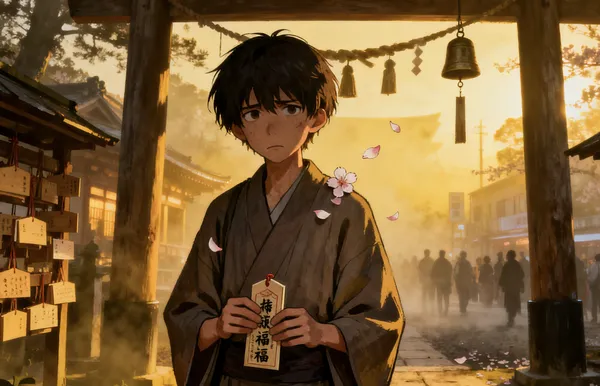
Is "Dai-kichi" Really Perfect? 3 Hidden Rules Behind Japanese Temple Fortunes
1. The Unlucky Soul Frozen by a "Bad Luck" Slip
During New Year's or holidays, temples are always packed with people eager to draw their fortunes.
You hear the shhh-clack sound of the bamboo cylinder shaking, and a stick falls out.
Someone cheers: "Master! It's the First Lot! Dai-kichi (Excellent Luck)!" It feels as if a promotion, a salary raise, and a dream partner are all guaranteed by tomorrow.
Others look at their paper with a face ashen as death: "Kyo (Bad Luck)... it's over. Is the entire universe conspiring against me this year?"
We see this scene all the time. But have you ever considered that the old monk at the temple might be sighing inwardly at the person ecstatic over "Excellent Luck," while smiling reassuringly at the one holding the "Bad Luck" slip?
Don't be too quick to object. Today, let's use the dual perspectives of folklore and modern psychology to uncover the 3 hidden logics behind the ranking of these Omikuji (fortune slips).
2. Logic 1: What Goes Up Must Come Down — Is "Dai-kichi" Actually a Warning?
In the philosophical system of the I Ching (Book of Changes), the world isn't static; it is a flowing circle.
So-called "Excellent Luck" or "Dai-kichi" represents the "Peak" of the luck curve.
Anyone who has climbed a mountain knows what standing at the peak means: it means that no matter which direction you take next, it is all downhill.
Traditional Eastern culture emphasizes that "fullness leads to loss." When you draw the No. 1 Lot (often a Dai-kichi, symbolizing an Emperor's rise), the fortune is often hinting: You are indeed in the best state right now, but if you aren't doubly careful and cultivate your character, your luck will be exhausted very quickly.
Conversely, the so-called "Bad Luck" or "Kyo" means you are currently at the bottom of the valley.
What is the benefit of the valley bottom? Bouncing back. As long as you keep walking, the only way is up.
Therefore, many wise monks will tell those who draw bad luck: "Knowing it is bad means you will be cautious; knowing caution brings the turning point."
3. Logic 2: Middle Luck — The Real "Player's Game"
Many people feel indifferent when they draw "Middle Luck" (Chuu-kichi) or "Future Luck" (Sue-kichi): "Meh, not good, not bad. Boring."
In reality, "Middle Luck" is the most realistic state of life and the state with the largest "Playable Scope."
- Dai-kichi (Excellent Luck): Luck makes up 90%. You tend to get arrogant.
- Kyo (Bad Luck): Environmental resistance makes up 90%. You tend to get scared.
- Middle Luck: Luck and resistance are 50/50. The remaining 50% depends entirely on your subjective initiative (agency).
It's like playing a video game. Excellent Luck is the "Official Cheat Code," Bad Luck is "Hell Mode," but Middle Luck is the standard "Fair Play Mode." If you want to gain a sense of achievement through your own efforts, Middle Luck is actually the best slip. It tells you: "With just a little more effort, things will get better."
4. Logic 3: The Pygmalion Effect — Luck Is What You Believe It Is
From a psychological perspective, a fortune slip is a type of "Self-Fulfilling Prophecy."
If you draw a good fortune, you subconsciously become confident, optimistic, and calm. This positive "vibe" itself attracts good luck.
If you draw a bad fortune, you might become timid and paranoid. If you trip while walking, you'll think, "See, the omen was right," and subsequently give up on efforts you could have made.
The Omikuji itself has no magic; it is simply a magnifying glass for your subconscious.
5. Conclusion: Don't Let a Slip of Paper Define Your Year
Finally, here is some actionable advice.
- If you draw Good Luck: Keep it in your wallet as fuel for confidence, but remember not to be arrogant.
- If you draw Bad Luck: Follow the custom and tie it to the designated tree or rope rack at the temple (symbolizing "leaving the bad luck behind"). Then, walk out the gate, take a deep breath, and tell yourself: "Alert lifted, but I will proceed with caution this year."
As the saying goes:
"The fortune slip is not a verdict, but a hint for the level you are facing. The amount of EXP (Experience Points) you gain depends on your attitude toward the quest."
- Article category: 吉凶指南
- Article tags: 无
- Article views: 359 次浏览
- Post date: 2025-12-01 11:58:01
- Article url: https://temple.aitoolbooks.com/jixiong/116.html
- Prev: What to Do If You Draw a